
A USRPT Swimmer’s Thought Life
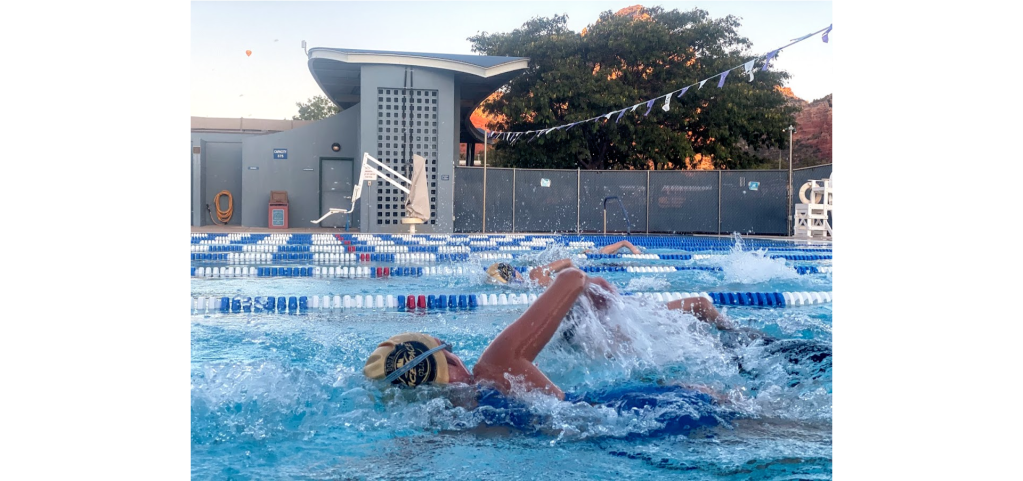
To those sitting on deck watching the average swimmer in traditional training slogging back and forth from one end of the pool to the other, the endeavor might seem endlessly boring. You might event think that some music playing over swim headphones might be in order.
“Oh, my child would never stay focused staring at a black line while he goes back and forth, back and forth,” I’ve heard parents say. But the thought life of USRPT swimmers is amazingly complex, and that black line is little more than a background prop to a very rich thought process.
Building a foundation
First, there’s technique. That’s the first thing that a race pace swimmer needs to be thinking about. For our new swimmers, that’s the only thing we have them focus on at first. And that’s not as simple as it sounds. There are eight different components to each stroke that our coaches teach.
They don’t just teach it once, either. It’s not unusual to hear a practice focused on one small aspect of a stroke — such as the hand entry or power phase — all week. That’s because permanent change happens only when the swimmer overlearns each concept, making it second nature in their brain and body. Otherwise, they’ll revert back to the old way that their neurology is “comfortable” with.
Revving things up
But once a newb swimmer has the basics, there are other things to think about. Like the fact that it’s called “race pace training” for a reason. The second step is to hold that technique while going as fast as you’d go in a race.
It’s based on the “Principle of Specificity” and it makes sense —learn good technique at a slow, easy pace and your body will be trained to swim slow and easy. But at that relaxed pace, things will invariably fall apart once you step up the effort, especially once fatigue sets in.
This adds more things to think about, including whether the new technique is improving your stroke count, if you’re improving your best time, making your fail time, and how many repetitions you’ve completed before you “fail out” of the set.
More advanced swimmers are also keeping track of their interval and any associated math, such as calculating when you need to leave the wall if you’re on a 55-second interval. You can even figure out what number repetition you’re on if you forget by doing the math in your head — provided, of course, that you made note of what time the set began.
Upping the mental game
So correct technique at high speeds and lots of math including intervals and various time goals are all being simultaneously kept track of in the head of a swimmer. But there’s even more mental aspects to USRPT training with Sedona Race Pace Club. The training helps swimmers connect with their inner athlete and improve their mental game early on in life — a skill they’ll take with them throughout a lifetime. Things like:
- Learning to set goals
- Understanding how to break down the goals to create actionable plans
- Experiencing short-term failure as a positive step to achieving long-term goals
- Developing focus
- Learning to coach themselves through tough situations and anxiety through self-talk
- Using visualization and small steps to achieve and condition desired outcomes.
Having fun while learning
Don’t indulge the fear that maybe your kids just aren’t up to all this mental activity. The process is laid out gradually by the Head Coach Sean Emery and his assistant coaches according to each swimmer’s skill level and capabilities. Other teammates help inexperienced swimmers learn how to keep track of the various things as they are presented.
All the while, children are not just learning to swim better, they’re learning ways to cope with challenges that will translate into their outside life as well. It’s not unusual to hear a parent warmly comment that their child has suddenly done better in other areas of life such as music, mathematics, sports or social skills.
The fun factor of team-building activities, the constant opportunity of feedback of bettering their performance in some aspect each day leads to many of our kids becoming self motivated. They look forward to being in the pool each workout to achieve small successes and betterments that
As one of our swim moms put it, “The payoff isn’t in seeing a best time at a meet or even a first place. It’s in seeing him be so motivated about something he truly loves doing that he’s rolling out of bed at 4:30 a.m. ready to go.”
The sound of a self-motivated teenager? Now that is music to everyone’s ears!
Call Head Coach Sean Emery at 928.254.7765 to find out more about how training with our Sedona, AZ, swim team can benefit your child both in and out of the water.
 Off the Wall