
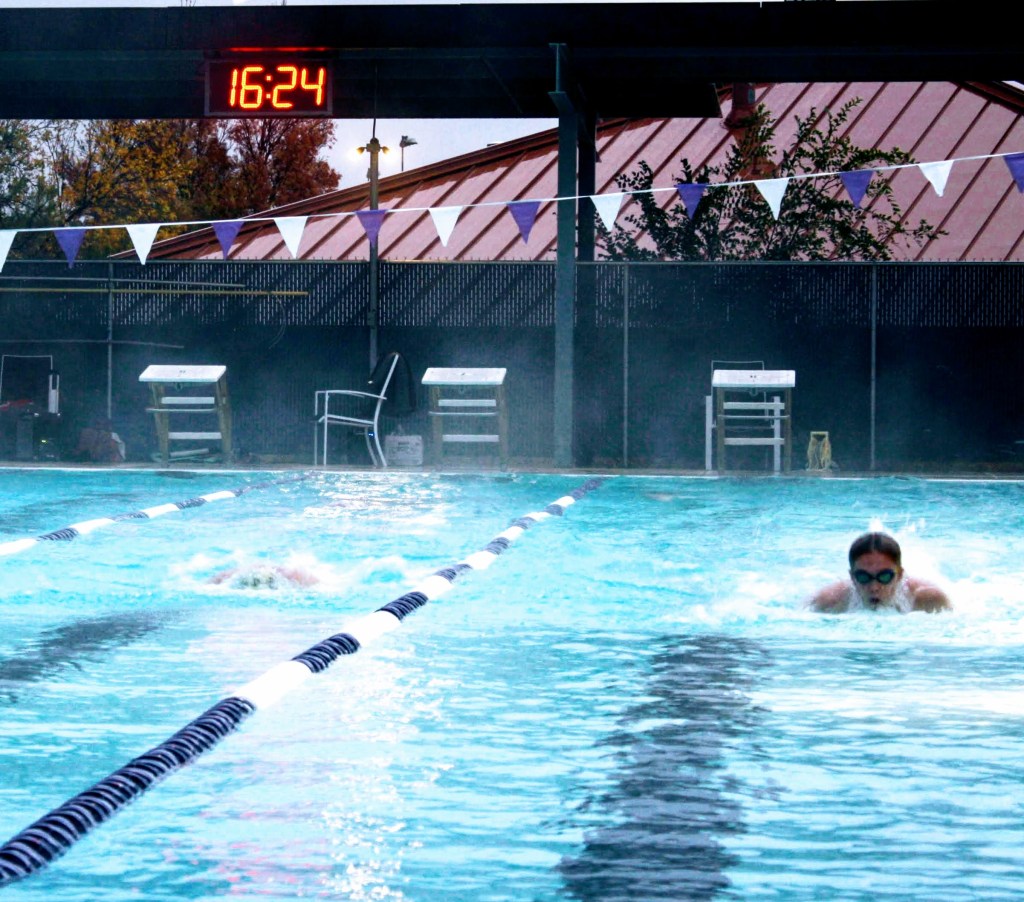
With so much to think about during USRPT training, it’s not too difficult for swimmers to lose track of how many reps you’ve done, especially when you’re doing a set that might have 40 or 50 reps. Learn a few basic calculations using the pace clock and you’ll easily be able to get back on track.
Losing track of reps
There are so many things that a USRPT swimmer thinks about during a set: a specific aspect of stroke technique, meeting the goal time, what interval to leave on, what their time is, how many failed reps, etc. So it’s not difficult to let the total number of reps escape the brain while focusing on other things, especially when the body begins to get fatigued.
It can be particularly challenging when you’ve done approximately the same number of reps as the time the coach is calling out. Say, for example, that you just did a 25 yard swim in 15 seconds and you’re on rep No. 13. When the coach calls out “15,” your mind might naturally latch onto the 15 as the number of reps you’ve done.
Some swimmers will keep track by turning a piece of their equipment such as a flipper or kickboard by a quarter-turn every 5 reps. But the easiest way is just by watching the clock.
Tracking reps like clockwork
Look at the time that you’ll be starting the first rep and remember it: That is the key to tracking the number of repetitions. Just multiply the number of reps you’re doing by your interval time and you’ll know what time the set will finish.
The easiest example is a one-minute interval. If your first push-off for the set is at exactly 6:00 a.m. [0:00 on the Sedona Community Pool pace clocks], you’ll push off for your last swim in a set of 40 at 39:00. This wraps your 40-minute set up at the 40-minute mark.
You can easily calculate what rep you’re on at any time during the set. Your 10th rep will push off at 9:00, your 15th at 14:00, etc.
Of course, sets rarely start exactly at the top of the hour, so you will need to do a little figuring before you begin to get a feel for the set’s timing. However, it’s not too difficult to determine how long the set will take and what times you’ll be halfway [or ¼ or ¾ of the way] done with it.
Calculating other intervals
A 55-second interval set takes 36 minutes and 40 seconds to complete; a 50-second interval takes 33 minutes and 20 seconds. That means you’d swim your 40th repetition at 55 seconds leaving on 35:45 (completing the set at 36:40) if you started precisely at the top of the hour. You’d swim the 40th on a 50-second interval at 32:30 (completing the set at 33:20).
It’s also fairly easy to calculate your reps by when you push off the wall for each rep if you’re accurately leaving on your correct interval. For example, on a 55-second interval, you’ll leave 5 seconds earlier each rep. If you started the set on the “top” [:00], your next rep would leave on the :55, then the :50, then :45 and so on.
When you leave the wall on the :05, you know that’s rep no. 12 (as 60 seconds divided into 5 second segments equals 12) Pushing off for the second time on the :00 begins rep no. 13. So the second time you come around to the top is rep no. 25, and the third time is rep no. 37. That means you only need to count three more to reach 40, and you’ll be leaving on the :45 for the last swim.
The same idea holds true for 50 seconds, only you must leave 10 seconds earlier each time. So you’re leaving on the :00, the :50, the :40, the :30, etc. Each time you leave on the “top” again, you’ve completed six reps and are embarking on the seventh. You’ll complete the set leaving for the last rep on the :30 after having left on the “top” a total of seven times: on Reps 1, 7, 13, 19, 25, 31, and 37.
Are you ready to up your competitive swimming skills and improve your swim times? Visit our website at http://www.sedonaracepace.com or contact Coach Sean Emery at 928.254.7765
 Off the Wall