Each week, swimmers at Sedona Race Pace Club focus on a different aspect of their technique. Technique is crucial to the Ultra-Short Race Pace Training that we practice because it enables you to swim at maximum speed with the best leverage on the water— without injuring yourself.
Why recovery is important
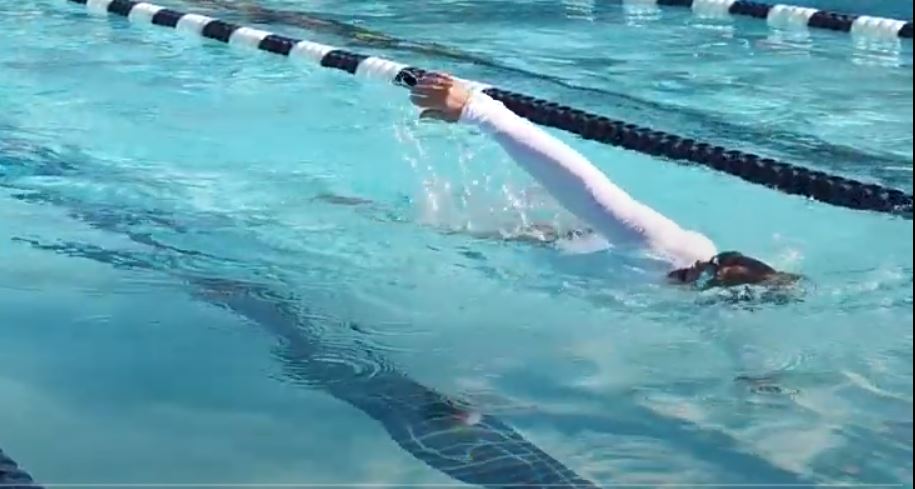
This week, we’re focused on stroke recovery. That is the part of the stroke from where the power phase completes and the arm repositions itself to make the initial action of the stroke. In breaststroke, the recovery phase takes place in the water, while the arm moves through the air for freestyle, backstroke, and butterfly.
It might seem surprising that how your hand and arm pass through the air or water while returning to the starting position matters as much as any other part of the stroke.
“Consideration of the recoveries in all strokes is important because how they are performed will cause reactions in other parts of a swimmer’s posture, which can have varying effects on propulsion.”
Brent Rushall, Ph.D., Professor Emeritus at San Diego State University and founder of USRPT
In strokes with alternate arm movement — freestyle and backstroke — what the out-of-water arm does affects how the other arm performs underwater. This is part of the body’s bi-lateral functioning: What you do with one side of the body is mirrored to a certain extent on the other side of the body.
So when the coach modifies a swimmer’s recovery arm action, the response doesn’t just affect the recovering arm. That means, the underwater mechanics can’t get ignored while working on the recovery technique for these alternating strokes.
Effects of improper recovery
For example, swinging your hand out wide when recovering on freestyle will make your underwater arm go wide in a far less efficient stroke pattern. You can’t effectively perform the correct body roll with your arm out wide, therefore, the amount of drag produced has a slowing effect on your overall stroke.
But that’s not the only thing that a wide recovery in freestyle does to your body. Your entire body is thrown out of an ideal streamlined posture with hips moving to the side to offset the wide arm and legs moving to the opposite side. Stroke rate slows since the non-streamlined stroke takes more time and effort to perform.
Arm recovery is equally as important in the other three strokes as well. In each, the best recovery technique is the one that takes the least amount of time, causes the least development of water resistance and doesn’t result in added counter-balancing movement and effort.
Elements of a great recovery
- A good recovery technique in any stroke keeps the body in a streamline and maximizes the forward movement with the least amount of effort needed.
- A good recovery technique positions the hand for the initial movement and eliminates unnecessary actions that increase resistance or require extra time.
- Coordinates with the propulsive action of the pulling arm in alternating strokes
- Keeps non-propulsive phases of symmetrical strokes (butterfly and breaststroke) to a minimum
- Create as little water resistance as possible
When you’re ready to take your stroke technique to the next level, contact Head Coach Sean Emery at 928.254.7765 to book in-person workouts with Sedona Race Pace Club in Sedona, Arizona, or a virtual session. Or visit sedonaracepace.com for more info.
 Off the Wall