Why Learning Technique at Race Pace Prevents Injuries

Why Learning Technique at Race Pace Prevents Injuries
“There’s a myth that’s going around that young swimmers should learn technique at slow speed,” said Brent Rushall, Ph.D., founder of Ultra-Short Race Pace Training (USRPT). “Science says that at slow speeds you’ll do one technique and at fast speeds, you’ll do a different technique.”

That means that all the technique you worked on while swimming easy is going to go right out the window once you’re striving for time. Falling into the wrong pattern is hard on the body also. “If you swim properly, you save your joints,” according to USRPT coach Peter Andrew. 

Training thousands of yards with bad technique leads to injuries: The most common, according to University of Pittsburgh Sports Medicine (UPMC)  include:

  • Irritation and inflammation in the shoulders
  • Rotator cuff tendonitis or tears
  • Shoulder impingement syndrome, which is a result of pressure on the rotator cuff muscles from part of the shoulder blade when the arm is lifted overhead
  • Tears in the cartilage around the shoulder socket
  • Neck and low back pain
  • Bicep tendonitis

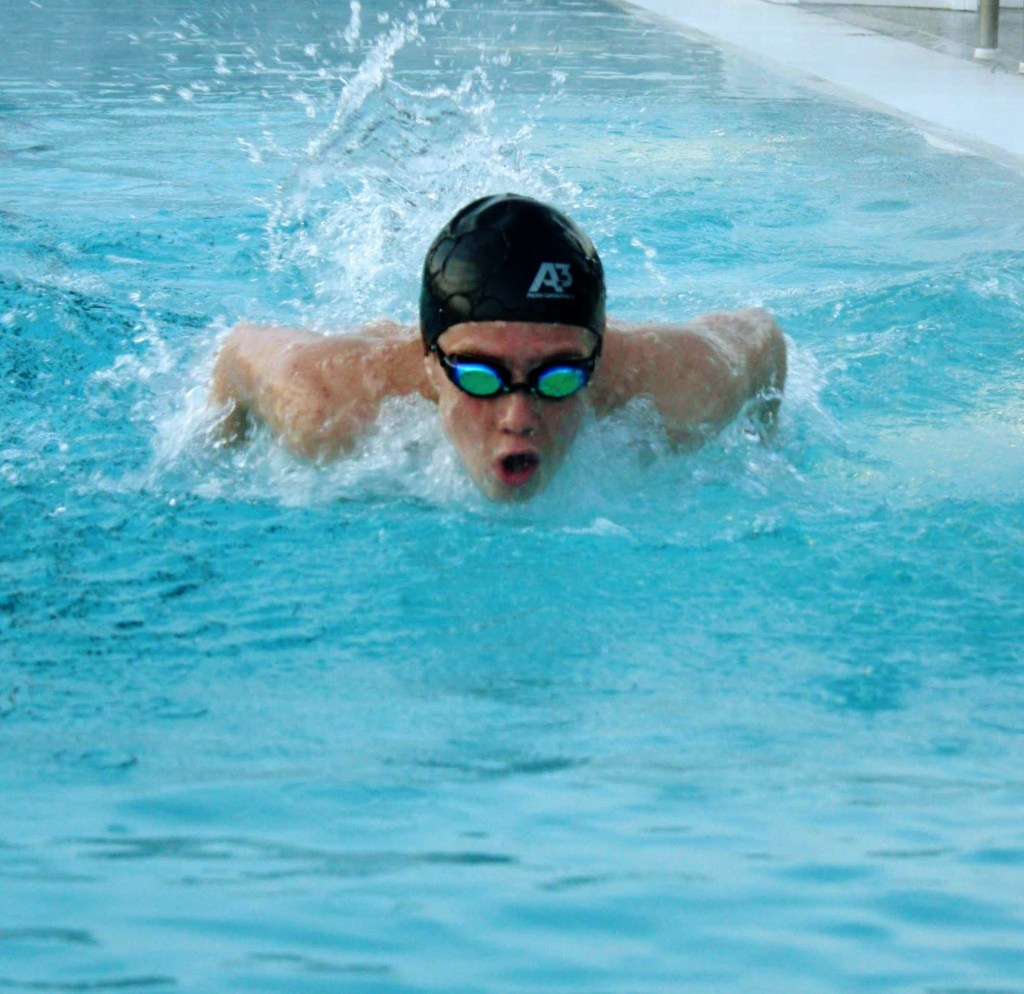
Overtraining with poor stroke mechanics and breathing technique are the top reasons cited by UPMC for these injuries. The medical center advises that proper stroke mechanics as the primary way to prevent injury, particularly head and body position, proper breathing technique and rotating the body during freestyle and backstroke. For butterfly and breaststroke, the emphasis is on body and head position, timing and proper kicking mechanics. 

Using USRPT training, Sedona Race Pace Club focuses on proper technique at the same speed and intensity swimmers use when racing in a swim meet. Even the littlest swimmers have a blast getting the feel for stroke mechanics and then striving to hold the form as they race against the coach’s stopwatch and their goal times.

Proper technique for each stroke is broken down into a number of components that are taught in cycles. The goals are to first reduce water resistance and secondly to move more effectively through the water. As nature intended, these body positions are also the easiest on the body. 

Body position in the water is key — head and hips should be aligned along the same horizontal plane in a streamlined position for the least resistance moving through the water. Then you can add in proper technique for breathing, arm movements, and kicking.  “Correct limb techniques can only be achieved when they are performed on an efficient, stable, central structure,” according to Rushall. 

Our head coach Sean Emery and his Sedona Race Pace Club coaches focus each week on one aspect of a stroke to help swimmers “overlearn” each principle. This week, for example, swimmers concentrate on the power phase of a stroke for maximum forward movement in the water. 

“If overlearning is not achieved, then over time, what should have been learned will regress back to what originally was done,” per Rushall. Reverting back to incorrect technique is likely to lead to injury, especially when swimming at  high velocity such as going “all out” in a race. 

So how is a swimmer supposed to hold the correct technique while racing? The feedback received from our Sedona swim team coaches help kids find and practice their best form at racing speeds, training their brain and bodies to “swim smarter, not harder” even at their top effort.

Are you interested in finding out more about getting your children or yourself enrolled in race pace training? Call Coach Sean Emery at 928.254.7765.

Technique Tuesday: Why USRPT? It’s Fun!

Ultra-Short Race Pace Training improves swimming technique in a challenging, game-like environment kids enjoy.

USRPT training is the most effective way to train a swimmer to achieve their best times in a meet, but another notable aspect of the method is that those who use it find it to be fun.

The system’s founder, Brent Rushall, Ph. D. notes, “The child growth and development people have shown that young children don’t like to do long, drawn-out, slow activities. “Just observe children being let out of class for recess, points out Dr. Rushall. “It’s not like they all go at slow speed and jog off. The games they play are all running games like chasing or tag — all high-intensity stuff. They just don’t do slow activity.”

As far as learning swimming technique at slow speeds, mile after mile, Rushall observes that children who do so “become very bored and very good at swimming slow.” 

And let’s face it: Pounding away at 5,000 yards freestyle or 1,000 butterfly is not fun no matter what your age or how slow you go. That’s why you see so many adult swimmers slogging away lap after lap listening to an underwater MP3 player to alleviate the boredom of staring at that black line mile after mile.

But the words of experts mean very little if things don’t translate into the pool. Enter USRPT and it’s inherent nature as a fun game that’s also an awesome training tool.

One of the things that intrigued me most when I first started coming in contact with the Sedona Race Pace Club was that the kids always looked liked they enjoyed what they were doing! That really caught my attention because it was very different than my own experience as a national-level swimmer where workout philosophy was “more pain, more gain.”

One teenage swimmer on our team readily agreed that the USRPT training method is fun, but particularly because the science of it backs it up. “It just doesn’t make sense that a person would swim long yardage at a slow pace to try to swim fast in a race,” he said. 

Not to mention the wear and tear on a person’s body, he mentioned. As the former owner of a body that was fully blown out with bursitis and adrenal fatigue by age 17 as the culmination of an 8-year swimming career, I was elated by his insight. 

When the young novice swimmers were asked after a USRPT workout what was the most fun, they immediately responded in unison with answers about the butterfly and breaststroke sets. Although these are two of the hardest swimming strokes — butterfly, for example, trains 27 different muscles — the youngsters were bubbling over with enthusiasm about their experiences. 

Their spontaneous responses fully confirmed what Dr. Rushall observes: Children have fun playing high-intensity games. The “game” of USRPT lets kids compete against their own best times on a daily basis. The game comes with rules and challenges, wins and fails, and a lot of excitement and bursts of intensity along the way.

The kids also mentioned they liked that it helped them feel more confident in the water as they “learn to swim better.” Insights shared by our swim parents confirm that this inner confidence translates into the world outside the pool as well. We love hearing how the kids are doing better at schoolwork, feeling more socially connected, becoming more focused and adept at extracurricular activities such as playing an instrument, or just spending more time interacting with the physical world rather than video games and online social networks. And in today’s world, when something is more fun than social media, it’s worth taking note!